Accessible Escape Room Features: What to Look For

An accessible escape room has a step-free route from the entrance to the game, space to move a wheelchair or walker, clues that do not depend on one sense, lighting and sound that are comfortable for everyone, and a game master who adapts the experience to your group. Most of that you can check before you book. Private rooms make it easier, because the only people in the room are your own group, and the pace, the hints and the team roles can be set around who is playing. At CodeBusters in Colorado Springs, every booking is a private room, and this guide shows you what to look for and what to ask.
TL;DR
- Check the whole route first: parking, entrance, doorways, restroom and the room itself. A continuous path at least 36 inches wide is the benchmark Colorado Springs uses for events.
- Good puzzles mix visual, tactile and audio clues, so no single sense or physical ability decides whether a player can contribute.
- Lighting, noise, timers and extra time matter for blind, low-vision, Deaf, hard-of-hearing and sensory-sensitive players.
- A private room lets the game master adjust hints and pace for your group alone.
- Tell the venue who is coming before you choose a room, so the room matches your group.
Table of Contents
- Why accessibility is easier to judge before you book
- Getting in: the route, the doors and the restroom
- Inside the room: layout and reach
- Clues and puzzles that work for more than one sense
- Light, sound and timers
- Communication: the game master and the hints
- What the rules say, in plain terms
- How to plan a group outing with mixed abilities
- Questions to ask an operator before choosing a room
- Our perspective
- Plan your private game with us
- FAQ
- Sources
Why accessibility is easier to judge before you book
Escape rooms are not one kind of building. Some are in ground-floor retail space with wide doors. Others use stairs, tight corridors, low crawl spaces or a set built around a ship or an aircraft. Two venues with the same star rating can be completely different for a guest who uses a wheelchair, has low vision or finds flashing light and loud sound overwhelming.
The City of Colorado Springs makes a useful point in its ADA guidance for special events: planning for accessibility from the start gives better and cheaper results than fixes added later. For a guest, the practical lesson is to ask about access as part of choosing a room, not after you arrive. The room that is the best story for your group should also be the room that fits everyone in it.
Getting in: the route, the doors and the restroom
Access starts outside the game. Walk through the visit in order and ask about each stage.
Parking and entrance
Look for accessible parking close to the door and an entrance without steps. Colorado Springs’ event guidance asks organizers to publicize where accessible parking and restrooms are, which is a fair standard to hold any venue to: you should be able to find out before the day.
Route width and surface
The same Colorado Springs document describes an accessible route as a single continuous path at least 36 inches wide, smooth, level and free of low or overhanging hazards. It also says surfaces should not be unstable, rough or steep, and grates should not have openings wider than 1/2 inch. A lobby that meets this is a good sign. For a wheelchair, also think about turning space, because a wide hallway does not help if you cannot turn into the game room. One venue guide suggests doors at least 32 inches wide, with room for a turning circle of about 60 inches, so a manual wheelchair can maneuver.

Restrooms and waiting areas
Ask whether the restroom is accessible and whether there is somewhere to sit before and after the game. A group often spends 30 minutes or more at a venue around a 60-minute game, so these details count.
If you want a structured way to think about this, the step-by-step logic in this mobility audit for accessible travel translates well: measure the route, check each transfer point, and confirm every answer in writing rather than assuming that “accessible” means the same thing everywhere.
Inside the room: layout and reach
The ERSE project, a European research collaboration on inclusive escape games, recommends designers prefer inclined planes over steps and keep spaces at least 1 meter (about 39 inches) wide. It also advises against hiding clues where players must climb or crawl, and suggests shelves and counters at heights everyone can reach.
Turn that into questions for the room you are considering:
- Is the floor level inside the room, or are there thresholds, raised platforms or steps between areas?
- Can a wheelchair or walker move between every puzzle station?
- Are clues and locks within seated reach, or do any require stooping, climbing or crawling?
- Can the group solve the room if one person stays in one area of it?
The last question matters most. Players do not each need to touch every puzzle. In the ERSE educators’ view, collaboration and mutual aid matter more than adapting every single puzzle: even if not every step suits everyone, the team structure is what makes the game inclusive. A good room spreads tasks so that reading, searching, sorting, calculating and communicating all count.
If stamina, stairs or reaching are on your mind, our guide to physical requirements for escape rooms covers what to expect before you pick a room.
Clues and puzzles that work for more than one sense
The strongest accessible feature is puzzle variety. When a room mixes things you read, things you touch, things you hear and things you arrange, nobody is shut out by one barrier.
For guests with low vision or reading difficulty, ERSE’s second design guide recommends large, high-contrast sans-serif fonts, simple vocabulary and pictures. It also advises checking that fine-motor puzzles are manageable, using accessible hardware for digital riddles, and adding sound and subtitles to video puzzles. Adaptation tools such as sign language and Braille are on its list too.
Here is what that looks like in practice:
| Player need | Feature that helps | What to ask |
|---|---|---|
| Wheelchair or walker | Level floor, 36 inch or wider paths, reachable clues | Is every puzzle reachable from a seated position? |
| Low vision | High-contrast, large print; even lighting; tactile clues | Can the lighting be raised? Are clues readable at arm’s length? |
| Deaf or hard of hearing | Written or captioned clues, visual hints, a way to talk to the game master without audio | How are hints delivered: spoken, written or on screen? |
| Sensory sensitivity | No strobe, calm sound, a break option | Are there flashing lights, loud effects or jump scares? |
| Cognitive or attention differences | Clear structure, simple wording, extra time | Can the game master give hints earlier and slow the pace? |
| Limited hand strength | Puzzles that do not need fine finger work | Are there small dials, tiny keys or tight locks? |
Light, sound and timers
Sensory design is where a room can quietly become hard or easy for someone. ERSE advises neutral, quiet music, or none, and lighting that is neither too dark for visually impaired players nor too bright for players with concentration problems. It also says to avoid strobe effects and to use visual timers or hourglasses instead of fast-scrolling countdowns, and to adjust total game time for players who need more time.
The point on timers is easy to overlook. A countdown clock can raise anxiety for some players, and the clock is part of the fun for others. If someone in your group is sensitive to pressure, ask whether the clock can be less prominent or the game extended.
Theme matters too. A dark, atmospheric story room feels different from a bright, puzzle-first room. When you contact a venue, describe your guests’ needs and ask which of its rooms is the calmest.
Communication: the game master and the hints
Staff behavior is an accessibility feature, and it costs nothing to check. The Colorado Springs guidance tells staff to see the whole person rather than the disability, avoid being overly protective, allow extra time to move, speak or perform tasks, and know where accessible features are.
For guests who are Deaf, hard of hearing or blind, the same document lists effective communication aids: large print, Braille, audio formats, readers, ASL interpreters, written materials, captioned videos and assisted listening devices. It also names the Rocky Mountain ADA Center and the City’s Office of Accessibility as places to ask for help.
One rule from federal court guidance is worth knowing as a guest. The National Center for State Courts’ ADA toolkit (May 2025, written for public entities, not private businesses) says the aid chosen by the person with a disability gets primary consideration. It also says staff may ask only two questions about a service animal: whether it is a service animal and what task it performs. Documentation cannot be required. These are Title II rules for government services, but they describe good practice for any venue. One guide for disability-friendly escape rooms, from Disability:South Africa, puts it simply: let the person establish how they want to communicate, whether by lip reading, sign language or writing notes.

What the rules say, in plain terms
If you organize events, it helps to know the legal backdrop, which is often misunderstood.
The 2010 ADA Standards for Accessible Design set the minimum requirements for new or altered public accommodations and commercial facilities to be readily accessible to people with disabilities. These cover physical features such as routes, doors and restrooms. They do not design the puzzles. How a game adapts to a specific guest is up to the venue and its staff.
Safety codes matter as well. Lori Greene of Allegion, a building-hardware specialist, reports that the 2024 I-Codes removed an earlier provision that let puzzle-room locks be released by a fire alarm, sprinkler system or attendant. Under the current model codes, puzzle rooms with unlocked, readily identifiable, always-available exits are not required to follow the special amusement area section, and she expects most owners to take that route. For you as a guest, this is reassuring: a player who needs to leave, for any reason, can leave. Codes are adopted locally, so the rule that applies is whichever your jurisdiction has adopted.
How to plan a group outing with mixed abilities
A short routine works better than hoping for the best.
- List your group’s needs. Mobility, vision, hearing, sensory sensitivities, stamina, age range, and anyone who may need a break.
- Shortlist rooms by layout, not only by theme. A room set in an airplane or on a ship has a different layout from a game-night or museum setting. Read each room’s description on our rooms page.
- Contact the venue before you book. Describe who is coming and ask the questions in the next section.
- Choose the private room. With only your group inside, you can set the pace and use hints as often as you need.
- Assign roles. Put a reader, a searcher, a sorter and a caller on the team so every strength counts. Our guide to the role of collaboration in escape rooms shows how teams divide the work.
- Arrive early. Look at the route, restroom and waiting area before the game starts.
Questions to ask an operator before choosing a room
- Is there a step-free route from parking to the room and to the restroom?
- How wide are the doors and corridors, and is there space to turn a wheelchair?
- Which room has the least climbing, crawling, stooping or reaching?
- Are any effects loud, flashing or sudden? Can they be reduced?
- How are hints given, and can they be written or shown instead of spoken?
- Can the game run longer, or can hints come sooner, for players who need more time?
- Can someone sit out a puzzle, take a break or leave and rejoin without penalty?
- Is a service animal welcome in the room, and is there space for it?
A good venue answers these plainly and does not make you justify the question.
Our perspective
We run private escape rooms in Colorado Springs, and we believe the best room for a group is the one where everyone has something to do. That is why every booking is a private room: it is your team, your pace and your game.
We also think accessibility is a conversation, not a checkbox. The same person can find one room easy and another difficult, and a theme that suits one family may not suit another. With 13 rooms across two locations, including settings as different as a real airplane, a pirate ship and a game-night setup, we have the range to match rooms to groups.
Tell us who is coming and what would make the visit comfortable, and we will help you choose a room. A game works best when the whole team is part of it.
CodeBusters
Plan your private game with us
CodeBusters offers private escape rooms at two Colorado Springs locations, with themed adventures for different group sizes and difficulty levels, and rooms suited to large groups. We host birthday parties, family outings and corporate team-building sessions, and we offer discounts for military and veterans.
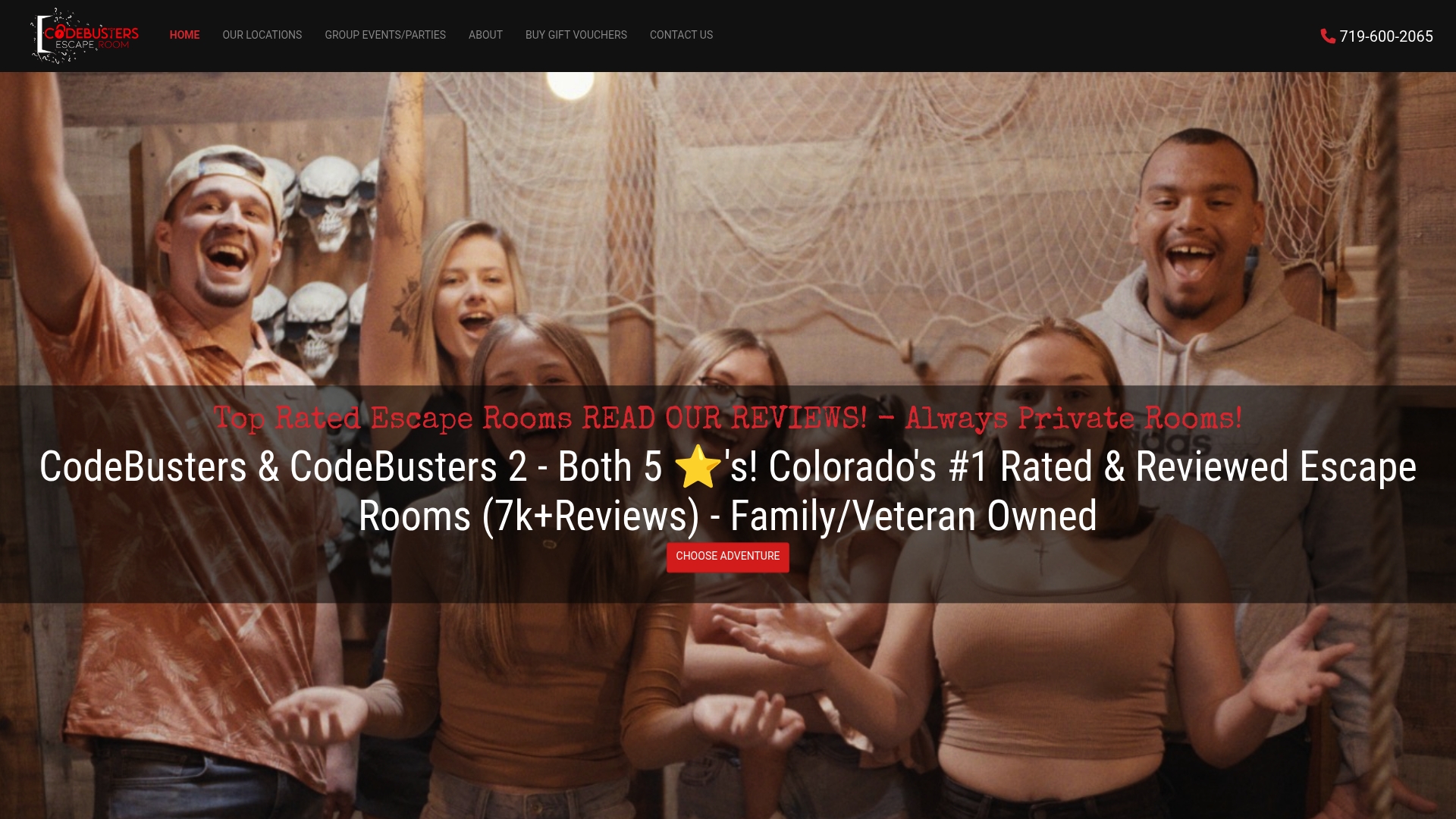
Browse the full list on our rooms page, see the group events options, or send us a note about your group’s needs before you pick a date. Gift vouchers are available for guests who want to choose the room together.
FAQ
What are some examples of accessibility features in an escape room?
Common features include a step-free entrance, wide doors and paths, an accessible restroom, clues within seated reach and puzzles that use sight, touch and sound. Others are readable fonts, calm lighting and sound, no strobe effects, visual timers, flexible game time and a game master who can adapt hints.
Can a wheelchair user play an escape room?
Often yes, but it depends on the building and the room. Ask about the route from parking to the game, door widths, floor level inside the room and whether every puzzle is reachable from a seated position. Rooms differ a lot, so choose by layout as well as theme.
How can Deaf or hard-of-hearing players take part?
Ask how the venue gives hints and instructions. Written or on-screen hints, captioned video and a clear way to talk to the game master help. Let the player say how they prefer to communicate, whether that is lip reading, sign language or notes.
Are escape rooms safe if someone needs to leave quickly?
Modern model fire codes lean toward rooms with unlocked, clearly marked exits that are always available. Codes are adopted locally, so ask the venue how exits work in the room you are booking and how a player can step out and rejoin.
Is a private room better for accessibility?
It helps. In a private room only your group is present, so the pace, hints and roles can fit the people playing, and nobody else is affected by extra time or breaks.
Sources
- Colorado Springs: Special Events ADA and City Accessibility Requirements, 2024 addendum
- ERSE: How to develop an inclusive and accessible educational escape game, part 1
- ERSE: How to develop an inclusive and accessible pedagogical escape game, part 2
- Serving People With Disabilities and Title II of the ADA: toolkit, May 2025
- 2010 ADA Standards for Accessible Design
- Code Update: Escape Rooms, I Dig Hardware, 2024 I-Codes
- Disability-Friendly Escape Room Quick Guide, Disability:South Africa
- 5 Step Mobility Audit for Wheelchair Accessible Yacht Charters