Corporate Wellness in Colorado Springs: Team Activities

A corporate wellness program in Colorado Springs works when employees actually show up for it. The best way to get them there is to pair the health basics (screenings, movement, mental-health support) with a shared activity people look forward to. A private escape room is one of the easiest to organize: your team solves puzzles together, away from the desk, in a room booked for your group alone. We run those rooms at two Colorado Springs locations, and this guide shows where a group activity belongs in a wellness plan and how to build the plan around it.
TL;DR
- A workplace wellness program is broader than a gym perk. The CDC counts programs, policies, benefits and environmental supports.
- Start with what your employees say they need, then pick activities. Assessment comes before selection.
- Group activities that build connection and give people a break from screens belong in the mix next to screenings, movement and mental-health resources.
- A private escape room suits teams from small departments to large groups, and it takes one booking to organize.
- Track participation and employee feedback after each event, and adjust the next one.
Table of Contents
- What a corporate wellness program includes
- Start with your people, not the activity list
- Where group activities fit
- Why a private escape room works for a wellness plan
- Building the event into your program
- Budgeting and measuring a wellness program
- Promo: book a private room for your team
- Our perspective
- FAQ
- Sources
What a corporate wellness program includes
Many Colorado Springs employers hear “wellness” and think of a gym stipend. The CDC takes a wider view. Its guidance on building a workplace health program groups workplace interventions into four kinds: health-related programs, policies, health benefits and environmental supports. A program can be a class, but it can also be a flexible-schedule policy, a benefit, or a change to the workspace.
The CDC’s 2014 overview of workplace wellness services lists employee assistance programs, health coaching, nutrition and healthy-living classes, gym access, smoking cessation, screenings, web resources and flu shots. The University of South Florida’s guide to employee wellness programs goes further. It names flexible schedules, work-life-balance initiatives, ergonomic equipment, healthy snacks, meditation, financial education, community service and fun workplace activities.
That last item matters for this article. A fun group activity is a recognized part of a wellness program, not an afterthought. The Global Wellness Institute describes the same spread: screenings, fitness amenities, healthy food, educational programming, counseling and participation incentives.
In practice, most programs for a company of 20 to 500 people end up with a few layers:
- Health basics: screenings, flu shots, and access to primary care or counseling.
- Movement and nutrition: walking challenges, fitness subsidies, healthy snacks.
- Mental well-being: employee assistance programs, mindfulness sessions, reasonable workloads.
- Connection: team outings, shared problem-solving, recognition events.
The fourth layer is the one that is most often missing, and the one where a Colorado Springs employer has the most local options.
Start with your people, not the activity list
Before you pick anything, find out what your employees want. The CDC’s building guide organizes the work into four phases: assessment, planning, implementation and evaluation. In the assessment phase it recommends looking at individual factors, workplace conditions and organizational culture, using employee conversations, surveys and environmental audits.

RAND’s five-step toolkit follows the same arc of planning, implementing and evaluating. It also notes that program design and execution vary a great deal from one employer to the next, which is a good reason to build yours around your own staff rather than copy another company’s menu.
A local example: Colorado-based U.S. Engineering, in a Health Links Certified case study, surveyed employee needs and formed a seven-member wellness steering committee before launching. Its program included a fitness room, a water refill station, healthy snacks, sponsored walks and runs, and an employee-and-family 5K. Colorado Springs Utilities reported in August 2025 that it received a Health Links award and described its approach as Total Worker Health, covering physical and mental health, financial stability and community engagement.
The takeaway is not to copy those programs. It is to notice the pattern: ask first, form a small group to own the plan, and mix several kinds of activity.
A five-question survey that does the job
You do not need a consultant to run the assessment. Send a short anonymous survey and ask:
- Which of these would you actually use: fitness support, mental-health resources, healthy food, team events, flexible scheduling?
- What gets in the way of joining activities (time, location, cost, schedule)?
- Would you prefer activities during work hours, after work, or on a weekend?
- Would you bring family to some events?
- What is one thing that would make your week less stressful?
The answers tell you which layers to build first. If “team events” and “schedule” both score high, a midday group activity that fits inside a normal workday is a strong first step.
Where group activities fit
Health screenings and benefits do their work quietly. Group activities do something different: they give people a reason to talk to colleagues they rarely see. For a hybrid team, a new hire, or two departments that never cross paths, that shared time is the point.
Research on workplace interventions gives you a reason to build a mix rather than rely on one tool. A 2025 overview of 88 reviews found modest effects across several intervention areas, including reducing sedentary behavior, promoting physical activity and healthier diets, and multicomponent programs. It also found the most consistent effects across psychological outcomes and occupational groups for mindfulness. Taken together, that supports a program with several parts: some movement, some attention to mental well-being, and varied formats.
A group activity can sit in that mix in a few ways:
- A kickoff event when you launch the program, so it starts with enthusiasm rather than an email.
- A recurring quarterly outing that gives every team a predictable break.
- A reward for teams that hit participation goals in a walking or steps challenge.
- An onboarding step so new employees meet colleagues in a relaxed setting. We cover that in more detail in our HR guide to escape rooms for new-hire integration.
Outside the box, tabletop and role-play formats also show how collaborative play can support well-being, as in this piece on role-play as a collaborative activity. An escape room applies the same idea to a whole team at once: everyone has a role, and the room only opens when people share what they find.
Why a private escape room works for a wellness plan
Employers choose group activities for practical reasons. They want something that fits a lunch break or an afternoon, that mixes confident and quiet employees, and that does not require athletic ability. An escape room checks those boxes, and ours add a few more.
Always private. Every booking at CodeBusters is a private room. Your colleagues are not paired with strangers, so the group can talk freely, and the conversation stays within the team.
Variety for different groups. We have 13 themed rooms across two Colorado Springs locations, with different group sizes and difficulty levels. That matters when you are organizing for a mix of ages and experience, or when the same team comes back a second time and wants something new.
Rooms suited for large groups. If your department is bigger than a handful of people, we have rooms that handle larger groups, so you do not have to split a team across several sessions.
Immersive settings. Some of our rooms put you in a real airplane or aboard a pirate ship. A setting like that pulls people out of their work mindset in a way a conference room cannot.
Easy to organize. You book online, and payment is made in person. For the person organizing, that is one reservation rather than a vendor search and a contract.
Veteran and family owned. We are a family and veteran owned business, and we offer discounts for military and veterans, which is relevant in a city with Fort Carson, Peterson Space Force Base and the Air Force Academy nearby.
We also hold a rating of Colorado’s #1 rated escape rooms, with more than 8,500 reviews, as our own claim on our site.

Matching rooms to teams
There is no single right room. Here is how we would think about it for a few common workplace situations.
| Situation | A room to look at | Why it fits |
|---|---|---|
| Mixed-age team or a family-friendly company event | The Great Gamenight Escape | A game-night theme is familiar and easy to join. |
| A team that likes a story and a twist | Flight of Deception: The Royal Takeover | A narrative adventure with a clear goal for everyone. |
| A group that wants a big, memorable setting | Flying Dutchman | A pirate ship setting that feels like a real outing. |
| Tech or engineering teams | Space: Knocked Off Course | Space puzzles with plenty of roles to share. |
| Teams that enjoy a classic challenge | Jigsaw’s Lair | An intense room for groups that want a harder test. |
| A team that likes history and discovery | Overnight at the Museum | An exploration theme with lots of things to find. |
| A first-time group | Past to the Future | A time-travel story that gives everyone something to do. |
You can see every room, with its group size and difficulty, on our rooms page.
Building the event into your program
Here is a simple sequence for a wellness coordinator or HR lead who wants to add a group activity without making it a big project.
1. Set a goal you can measure
Pick something small and concrete. “Every team joins at least one group activity this quarter” is easier to track than “improve morale.” The CDC’s evaluation guidance asks you to assess sustainability and reception, and to use the results for continuous improvement, so decide what you will count before you start.
2. Choose a time that works for the whole team
Your survey will tell you whether people prefer work hours or after work. A midday or late-afternoon session keeps participation high because no one has to give up personal time. Schedule early enough that people can plan around it.
3. Book the right size
Count confirmed attendees, then match them to a room. If your department is large, ask us about our larger-group rooms when you book. If you are organizing multiple teams, you can plan several sessions on the same day so everyone participates.
4. Add a meal or break
A shared meal turns the outing into a real break. If you are planning food, these corporate lunch menu ideas can help with the format for a team event. Pair a lighter menu with the activity so people are comfortable and energized afterward.
5. Follow up
Kaiser Permanente’s employer guide recommends tracking participation, progress and employee interest through surveys, then sharing positive outcomes and adjusting the program based on what you learn. Do the same here: send a two-question survey the next day (what did you enjoy, what would you change) and share the results with the team.
For more planning ideas, our guides on team-building events in Colorado Springs and team-building activity ideas go deeper on formats. If you are planning a larger day away, see our guide to a corporate retreat in Colorado Springs. For recognition, our employee appreciation ideas pair well with a group outing.
Budgeting and measuring a wellness program
Costs in a wellness program come in layers. Some are per-person, like a primary care membership. In December 2024, the Colorado Springs Chamber & EDC reported a member partnership offering membership-based primary care starting at $64 per month after the Chamber discount, with three Colorado Springs clinics at that time. Check the Chamber for the current terms.
Other costs are per-event, like a team outing. Keep those on a separate line so you can see what each layer costs and what each delivers. Ask for the group’s booking details when you reserve, and confirm the total before the event.
When you review the year, the CDC’s guidance says to measure return on investment where relevant, identify gaps, and use results to make resource decisions. For a team outing, the useful numbers are simple: how many people joined, how many said they would do it again, and whether the teams that took part report better working relationships in your next survey.
Promo: book a private room for your team
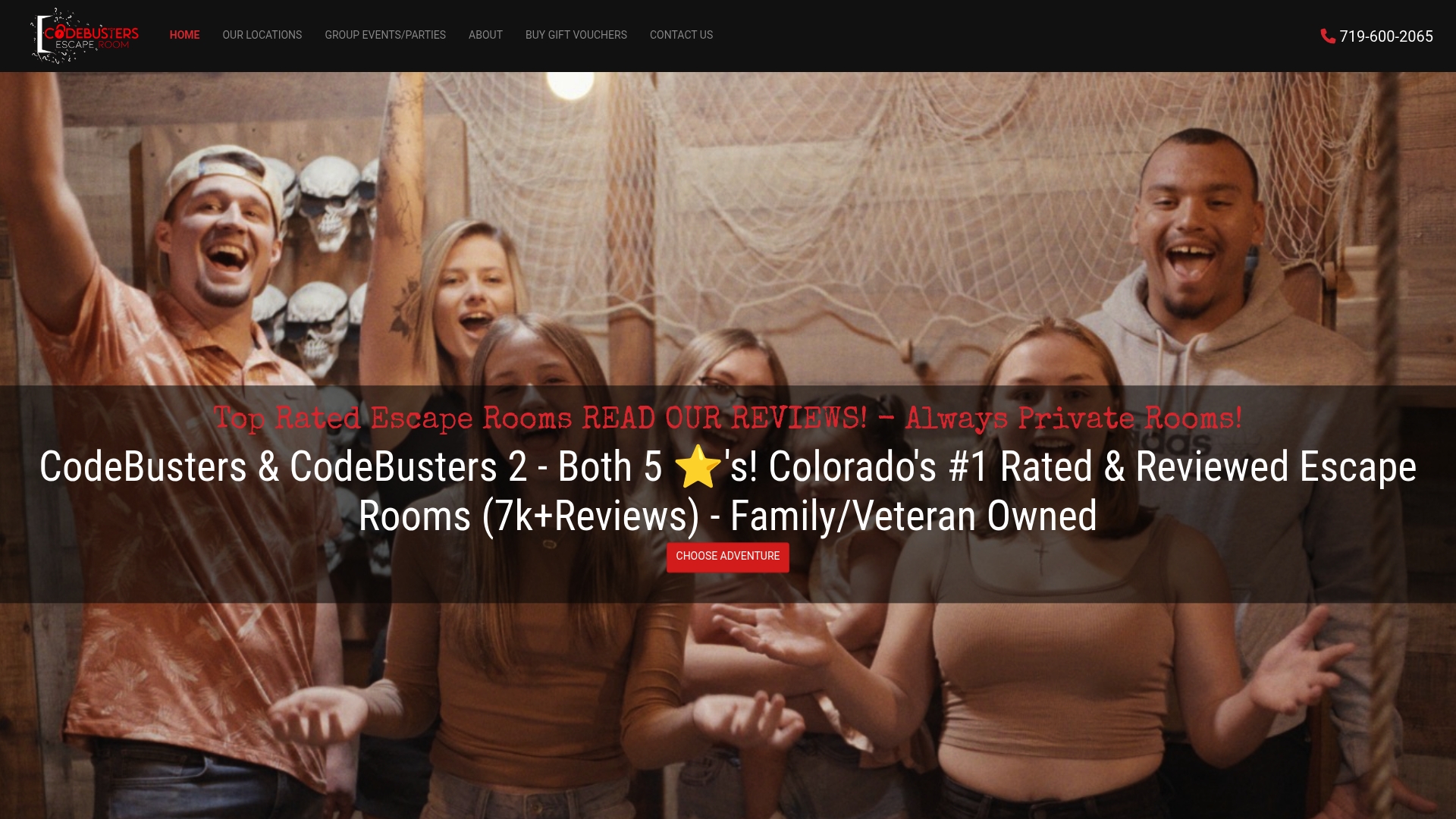
If you are adding a group activity to your wellness program this year, we can help you pick a room and set a time. Our rooms are always private, we have 13 themed rooms across two Colorado Springs locations, and we offer military and veteran discounts. Browse the full list on our rooms page and reserve online, or start from our home page to see both locations.
Gift vouchers are also available if you want to reward a team with an outing rather than schedule one.
Our perspective
Most wellness plans we hear about are heavy on benefits and light on the thing that makes people feel part of a team. We think the missing piece is shared time. When a group of coworkers is locked in a room with a goal, the org chart disappears. The new hire reads the clue the director missed. The person who never speaks in meetings finds the code.
That is why we build every room around a story and a team goal, and why every booking is private. Your group is the only group in the room. We have rooms for different sizes and difficulty levels, a real airplane and a pirate ship among our settings, and over 8,500 reviews from people who have played with us.
We are a family and veteran owned business in Colorado Springs, and we like working with local employers. If you are building a wellness program, put a group outing on the calendar and give people something to look forward to. We will take care of the rest of the room.
CodeBusters
FAQ
What counts as a corporate wellness program?
The CDC describes workplace health efforts as programs, policies, benefits and environmental supports. That can include screenings, coaching, classes, gym access and flexible schedules. Group activities and fun workplace events are also named in university guidance on wellness programs.
How do I get employees to join wellness activities?
Ask them first. The CDC recommends employee conversations, surveys and environmental audits before you choose interventions. Then offer a mix of activities, schedule them at times that work, and track participation so you can adjust.
Is an escape room a good team activity for a wellness program?
Yes, as one part of a mix. It gives your team a shared goal, a break from screens and a reason to communicate. Our rooms are always private, so your group plays together without strangers, and we have rooms for different group sizes and difficulty levels.
How do I book a private room for a company group?
Choose a room on our rooms page, then book online. Payment is made in person. If your group is large, check which of our rooms fit your headcount before you reserve.
Do you offer discounts?
We offer discounts for military and veterans. We also sell gift vouchers, which work well as a reward for a team that reaches a participation goal.
Sources
- Strategies for Building a Workplace Health Program, CDC
- Placing Workplace Wellness in Context, Preventing Chronic Disease, CDC
- How to Create an Employee Wellness Program That Actually Works, University of South Florida
- Workplace Wellness, Global Wellness Institute
- Five Steps to a Successful Workplace Wellness Program, RAND
- U.S. Engineering case study, Health Links Certified
- A win for our employees, a win for our community, Colorado Springs Utilities
- Effectiveness of workplace interventions for health, 2025 overview
- Employee well-being program, Kaiser Permanente
- Chamber & EDC and Pinnacle Advanced Primary Care partnership, Colorado Springs Chamber & EDC