Escape rooms vs. other games: choosing the best group experience
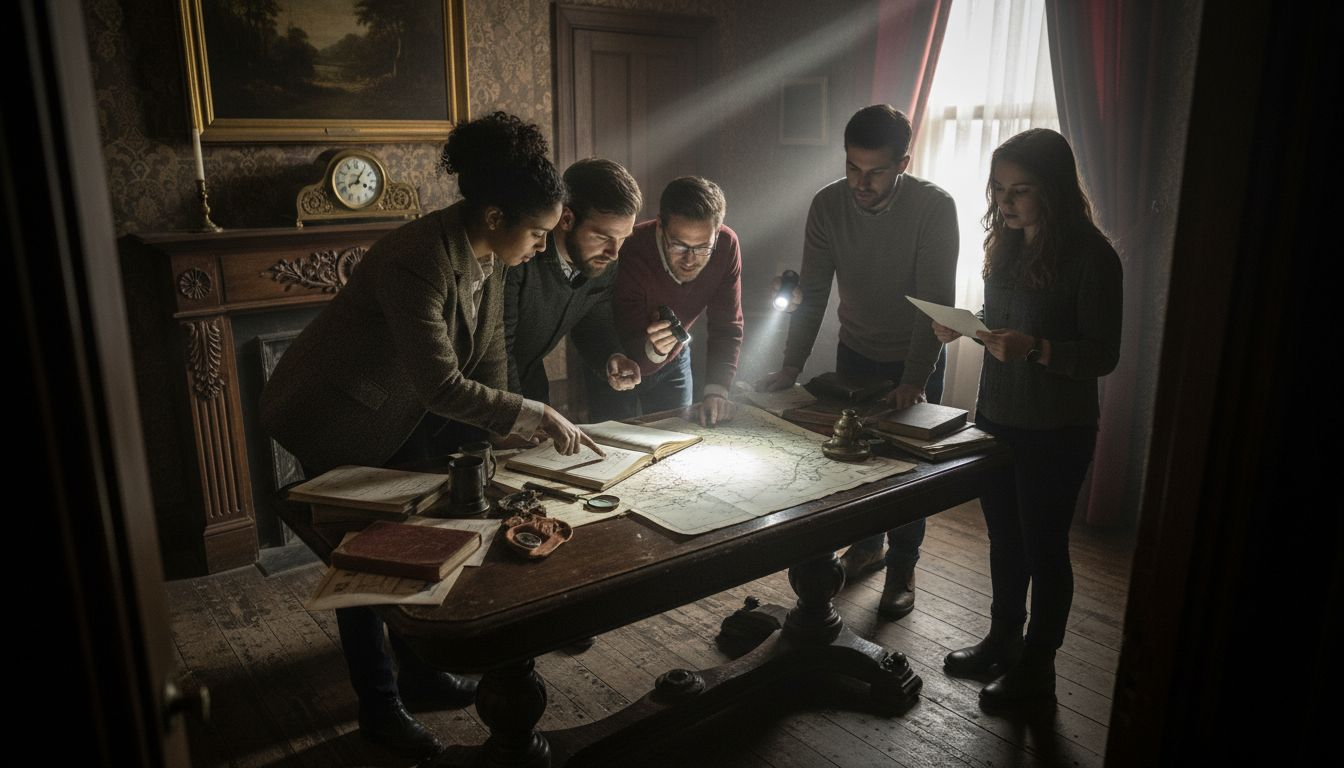
Teams that complete escape rooms report a 25% boost in communication and collaboration skills, a level of improvement that traditional board games or virtual activities rarely achieve. For escape room enthusiasts in Colorado Springs comparing escape rooms with other group gaming experiences, understanding what drives this difference can transform how you plan entertainment and team-building events. This article breaks down the unique benefits of escape rooms, debunks common misconceptions, and provides practical guidance to help you choose the ideal group gaming experience for your next outing.
Table of Contents
- Introduction To Escape Rooms And Group Games
- How Escape Rooms Facilitate Team Collaboration Differently
- Quantified Benefits Of Escape Rooms For Team-Building And Motivation
- Common Misconceptions About Escape Rooms Debunked
- Comparing Entertainment Value And Group Dynamics
- Practical Guidance For Choosing Between Escape Rooms And Other Group Games
- Conclusion: Why Escape Rooms Stand Out In Colorado Springs
- Explore Colorado Springs Escape Rooms Today
Key takeaways
| Point | Details |
|---|---|
| Escape rooms uniquely enhance collaboration | Synchronous problem-solving under time pressure promotes balanced participation and real-time teamwork unlike traditional games. |
| Measurable team-building advantages | Escape rooms improve team cohesion by 20-25%, significantly outperforming board games and virtual alternatives. |
| Misconceptions limit value understanding | Many believe escape rooms are puzzle-focused only, but 80% of players cite narrative immersion as the primary enjoyment driver. |
| Entertainment and social bonding excel | Escape rooms maintain 95% continuous engagement versus 60% in board games, with higher social interaction scores. |
| Group size and goals drive choice | Optimal groups range from 4 to 8 players for maximum engagement, with logistical factors like private bookings influencing decisions. |
Introduction to escape rooms and group games
Escape rooms are immersive, timed puzzle-solving group games where participants work together to solve interconnected challenges and escape a themed environment within a set timeframe, typically 60 minutes. Escape rooms in Colorado Springs have grown in popularity as entertainment and team-building venues, offering private, themed experiences designed to engage small to medium groups. Other popular group games include traditional board games like strategy and party games, virtual escape games played online, and recreational sports activities. Each category serves entertainment and social bonding purposes but differs significantly in how participants interact, collaborate, and experience engagement.
Colorado Springs offers a vibrant group gaming scene with local venues emphasizing private, themed escape rooms that cater to families, corporate teams, and enthusiast groups. The focus on entertainment and team-building goals has driven demand for activities that combine fun with measurable skill development. Understanding these distinctions helps you select the best experience for your group’s size, preferences, and objectives.
Key characteristics of escape rooms include:
- Immersive storytelling with elaborate set designs
- Timed challenges requiring collective problem-solving
- Private bookings for personalized group experiences
- Multi-sensory engagement through physical and mental puzzles
Pro Tip: When comparing group games, prioritize activities that align with your primary goal, whether pure entertainment, skill-building, or both.
How escape rooms facilitate team collaboration differently
Escape rooms demand real-time, collective puzzle-solving where every participant contributes under a shared time constraint. Unlike board games where turns alternate and virtual games where physical presence is absent, escape rooms require synchronous collaboration under time pressure and create conditions where all team members must communicate continuously. This format naturally reduces dominance effects, where one or two voices overpower group discussions, because the volume and variety of puzzles require diverse skill sets and simultaneous attention from multiple players.
The multi-sensory engagement inherent in escape rooms keeps all players active and mentally involved. Physical puzzles, hidden clues, auditory cues, and visual riddles ensure that participants with different strengths find opportunities to contribute. In contrast, traditional board games often favor analytical thinkers or those familiar with game mechanics, while sports-based activities may exclude less physically capable members.
Comparing collaboration dynamics reveals:
- Escape rooms distribute tasks across team members naturally
- Board games concentrate decision-making with experienced players
- Virtual games lack physical interaction and spatial problem-solving
- Sports activities emphasize physical skill over cognitive teamwork
Pro Tip: For teams with varied skill sets, choose escape room team collaboration experiences to ensure everyone contributes meaningfully.
Quantified benefits of escape rooms for team-building and motivation
Escape rooms increase team cohesion and communication by 20-25%, compared to 10% to 15% improvements from traditional team-building activities like board games or trust exercises. This measurable advantage stems from the combination of shared goals, time pressure, and immersive narratives that elevate emotional investment and collaboration intensity. Data collected from corporate team-building events and recreational group outings consistently show that participants report higher motivation and stronger interpersonal connections after completing escape room challenges.

The fun combined with cognitive challenge raises motivation by 15% to 20% above baseline levels measured in other group activities. However, limitations exist for groups larger than 10 participants, where engagement begins to drop as individuals struggle to find active roles within the confined space and puzzle structure. Splitting large groups into smaller teams or selecting alternative games becomes necessary to maintain the collaborative benefits.
| Activity Type | Team Cohesion Increase | Motivation Boost | Optimal Group Size |
|---|---|---|---|
| Escape Rooms | 20-25% | 15-20% | 4-8 players |
| Board Games | 10-15% | 5-10% | 4-6 players |
| Virtual Games | 8-12% | 8-12% | 2-10 players |
| Sports Activities | 12-18% | 10-15% | 6-20 players |
Key factors driving escape room effectiveness:
- Shared urgency creates natural accountability
- Success depends on pooling diverse perspectives
- Immersive environments reduce self-consciousness
- Immediate feedback loops reinforce positive behaviors
For escape room team-building benefits, ensure your group size falls within the optimal range to maximize engagement and measurable outcomes.
Common misconceptions about escape rooms debunked
Many people assume escape rooms are purely puzzle-focused experiences that reward logical thinkers exclusively. In reality, 80% of players say narrative immersion drives enjoyment more than puzzle difficulty, highlighting how storytelling, atmosphere, and thematic design create memorable experiences independent of puzzle-solving prowess. The misconception that escape rooms cater only to enthusiasts or puzzle experts discourages casual players who would otherwise enjoy the accessible, guided nature of most commercial escape rooms.
Another common misunderstanding is that escape rooms require extensive prior experience or specialized knowledge. Most venues design rooms with balanced difficulty, clear instructions, and hint systems to accommodate beginners. The narrative framework provides context and motivation, making puzzles feel intuitive rather than abstract. This accessibility ensures that first-time players and casual groups find the experience fun and engaging without frustration.
Escape rooms also encourage leadership and dynamic decision-making within teams, contrary to the belief that they only test problem-solving skills. Participants naturally assume roles like coordinator, searcher, or puzzle-solver based on individual strengths, fostering organic leadership development. This dynamic contrasts with board games where roles are often predetermined by game mechanics.
Addressing misconceptions helps appreciate escape rooms’ unique value:
- Story immersion matters more than puzzle complexity
- Beginners enjoy escape rooms as much as enthusiasts
- Leadership and teamwork emerge naturally during play
- Hint systems ensure frustration-free experiences
Pro Tip: Research escape room misconceptions before your first visit to set realistic expectations and maximize enjoyment.
Comparing entertainment value and group dynamics
Escape rooms maintain 95% continuous engagement versus 60% in board games, where downtime between turns or waiting for other players reduces active participation. This difference in engagement pacing directly impacts entertainment value, as participants in escape rooms remain mentally and physically active throughout the entire session. Virtual escape games offer moderate engagement but lack the physical presence and spatial problem-solving that make traditional escape rooms compelling, resulting in 35% lower social interaction scores.
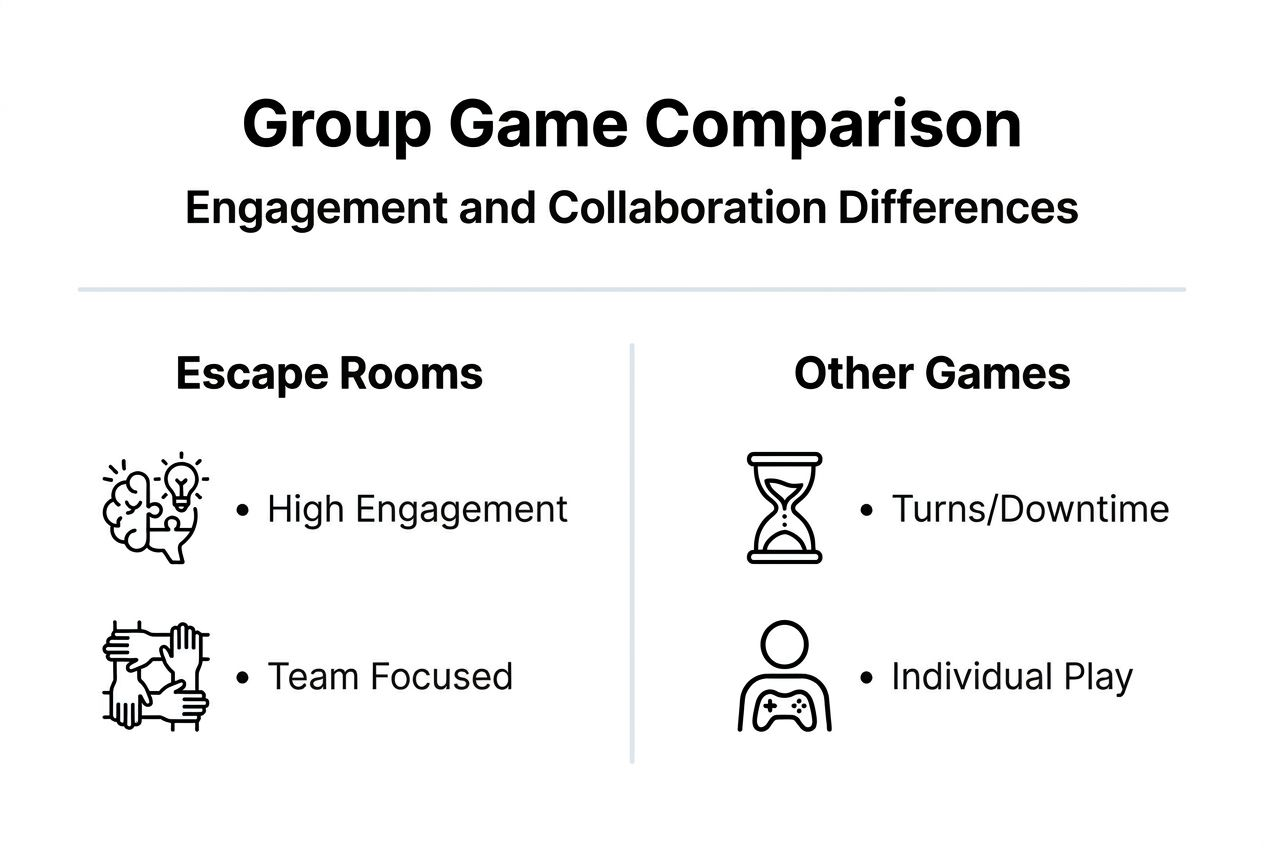
Group size flexibility varies widely across game types. Board games accommodate 4 to 6 players comfortably but struggle with larger groups due to turn-based mechanics. Sports activities scale well for 6 to 20 participants but exclude less physically capable members. Escape rooms balance intimacy and collaboration effectively for 4 to 8 players, though some venues offer larger rooms or multiple simultaneous sessions to accommodate bigger groups.
| Factor | Escape Rooms | Board Games | Virtual Games | Sports Activities |
|---|---|---|---|---|
| Engagement Level | 95% continuous | 60% intermittent | 70% continuous | 80% continuous |
| Social Interaction | High | Moderate | Low | High |
| Group Size Flexibility | 4-8 optimal | 4-6 optimal | 2-10 flexible | 6-20 optimal |
| Accessibility | Moderate | High | High | Low |
| Entertainment Pacing | Fast, immersive | Moderate, turn-based | Moderate, virtual | Fast, physical |
Entertainment pacing and accessibility differences significantly impact group experiences. Escape rooms offer fast-paced, immersive narratives that keep participants engaged but require physical presence and moderate mobility. Board games provide high accessibility and flexible pacing but lower engagement intensity. Virtual games offer convenience but sacrifice social bonding. Sports activities deliver high energy but exclude participants with physical limitations.
Key considerations when comparing entertainment value:
- Continuous engagement drives higher satisfaction
- Social interaction quality matters more than quantity
- Accessibility should match your group’s capabilities
- Pacing preferences vary by group demographics
For broader corporate event entertainment ideas or outdoor fun party games, consider how engagement and social dynamics align with your event goals. The escape room entertainment comparison reveals why immersive experiences often outperform traditional games for memorable group bonding.
Practical guidance for choosing between escape rooms and other group games
Selecting the best group gaming experience requires evaluating your specific situation using a decision matrix tailored to Colorado Springs enthusiasts. Follow these actionable steps to match your group’s needs with the right activity:
-
Evaluate group size and composition. Optimal group size for escape rooms is 4-8; larger groups should consider alternative games or multiple rooms to maintain engagement. Mixed-skill groups benefit from escape rooms’ natural role distribution, while competitive groups may prefer board games with clear win conditions.
-
Define primary goals. If team building and communication improvement are priorities, escape rooms deliver measurable benefits exceeding other options. For pure entertainment without skill development focus, board games or sports activities may suffice.
-
Consider narrative immersion importance. Groups valuing storytelling and thematic experiences should prioritize escape rooms. Those seeking straightforward competition or physical activity may prefer sports or strategy board games.
-
Account for logistical factors. Local availability, private booking options, and scheduling flexibility influence choices. Colorado Springs offers diverse escape room venues with themed experiences and private sessions, making them convenient for planned events.
-
Match activity to participant preferences. Survey your group on preferences for physical activity, puzzle-solving, or social interaction. Escape rooms balance all three but emphasize cognitive collaboration over physical exertion.
For small to mid-size groups seeking immersive teamwork experiences, escape room choices guidance recommends prioritizing venues with private bookings and varied difficulty levels. Groups prioritizing safety and structured environments can also explore options like bounce house safety tips for family-friendly alternatives.
Conclusion: why escape rooms stand out in Colorado Springs
Escape rooms blend immersive storytelling with effective teamwork in ways that board games, virtual alternatives, and sports activities cannot replicate. The combination of timed challenges, multi-sensory engagement, and narrative depth creates memorable experiences that drive measurable improvements in communication and collaboration. Local themed and private rooms in Colorado Springs amplify personalized group bonding, offering flexibility and variety that cater to diverse group sizes and preferences.
They uniquely support team-building and entertainment simultaneously, making them ideal for corporate events, family outings, and enthusiast gatherings. The Colorado Springs market benefits from diverse local Colorado Springs escape rooms that emphasize quality, accessibility, and private bookings. Whether you’re planning a team-building event or seeking the best group entertainment option, escape rooms deliver unmatched value by combining fun with functional skill development in an immersive, collaborative environment.
Explore Colorado Springs escape rooms today
Ready to experience the superior team-building and entertainment that escape rooms offer? CodeBusters Escape Room Colorado Springs provides themed, private escape room experiences designed for groups of all sizes and skill levels. With award-winning rooms like Past to the Future, Stranger 80’s, and Flight of Deception, you’ll find the perfect challenge to engage your team and create lasting memories.
Our veteran and family-owned facility prioritizes quality, immersion, and personalized service to ensure every visit exceeds expectations. Whether you’re organizing a corporate team-building event, planning a family outing, or seeking a unique entertainment option, our diverse room options and private booking flexibility make CodeBusters Escape Room Colorado Springs the top local choice for meaningful group experiences. Book your session today and discover why escape rooms consistently outperform other group games for engagement, collaboration, and fun.
FAQ
What group sizes are best for escape rooms?
Escape rooms are ideally suited for groups of 4 to 8 players to maximize engagement and collaboration. Smaller groups ensure everyone participates actively, while larger groups risk reducing individual involvement. Groups exceeding 10 participants should consider booking multiple rooms simultaneously or selecting alternative games that accommodate larger teams without engagement drop-offs.
Are escape rooms suitable for beginners and casual players?
Escape rooms are designed to be accessible, fun, and engaging for players of all experience levels. Most venues provide clear instructions, hint systems, and balanced difficulty to accommodate beginners. Narrative immersion provides enjoyment beyond puzzle expertise, ensuring casual players have memorable experiences without frustration. First-time participants often report high satisfaction due to the guided, thematic nature of commercial escape rooms.
How do escape rooms enhance team-building compared to other games?
Escape rooms require synchronous problem-solving under timed constraints, boosting teamwork through shared urgency and collective accountability. They reduce dominance effects and increase balanced participation by distributing tasks across diverse skill sets. Escape rooms improve team cohesion and communication by up to 25%, outperforming traditional activities like board games or trust exercises that offer 10% to 15% improvements.
What are the main entertainment advantages of escape rooms?
Escape rooms deliver 95% continuous engagement compared to 60% in board games, keeping participants mentally and physically active throughout the entire session. High social interaction scores result from collaborative puzzle-solving and immersive narratives. The combination of storytelling, sensory engagement, and real-time teamwork creates memorable experiences that board games and virtual alternatives struggle to replicate, making escape rooms a top choice for entertainment value.
How do I choose between escape rooms and other group games?
Evaluate your group size, primary goals, and participant preferences using a decision matrix. Escape rooms excel for groups of 4 to 8 seeking immersive team-building experiences with measurable collaboration benefits. Board games suit smaller, casual groups prioritizing accessibility and flexible pacing. Sports activities accommodate larger groups emphasizing physical activity. Consider logistical factors like local availability and private booking options to match your specific situation with the ideal activity.